Friday, July 27, 2012

Lightning article featuring Tim Samaras in August National Geographic


As I wrote in this blog a month ago, I'm taking a break this summer from case study posts.  However, I do want to mention that National Geographic is running an excellent article on my severe weather researcher friend Tim Samaras and his lightning photography quest. 


The article and accompanying images are in the August 2012 issue of National Geographic magazine.  Here's the cover:


credit: National Geographic

And here are some images from the article, shown with National Geographic permission:


© Carsten Peter

© Carsten Peter

© Carsten Peter

Here's an online link to other photos:
http://ngm.nationalgeographic.com/2012/08/chasing-lightning/peter-photography

A portion of Nat Geo's press release:

Using the world's fastest high-resolution camera housed in a mobile trailer, Tim Samaras hopes to be the first to photograph the micro-second event (not visible to the naked eye) that triggers a lightning strike. Through this, Samaras hopes to discover clues to some of lightning's biggest mysteries: Why will a lightning bolt sometimes strike a low tree when right beside it is a tall metal tower? And why, for that matter, does lightning strike at all?


He is used to having people tell him that what he’s trying can’t be done. But before he became obsessed with lightning, Samaras spent several years chasing after tornadoes to deploy electronic probes, mounted with video cameras and other instruments, to record what it looks and feels like from inside.  People were dubious about that too, but he managed to gather some of the most accurate readings ever of wind speed, barometric pressure, temperature, humidity inside a tornado vortex.


Congratulations, Tim...  As always, great work!

Jon Davies - 7/27/12

Saturday, June 30, 2012

Taking a break...


Wow... June has gone by and no blog posts.  I've had a lot going on personally the last month, and there's a bunch of stuff for me to work through the rest of the summer.

I'm going to continue to take a break to sort some things out.  Sorry about that.  I know I have a small loyal following of weather enthusiasts who like to read and learn about severe weather and forecasting.  I'll see if I can get back to posting some occasional case studies this fall.
 
For those who read my stuff, thanks so much for your patience.

Jon  6-30-12

Sunday, May 20, 2012

Prolific non-supercell tornado outbreak in Kansas 5/19/12 !!!


Yesterday (May 19) in south-central Kansas was a great reminder that potentially strong tornadoes (see images above near Rago KS in the 6:30-6:45 pm CDT / 2330-2345 UTC time frame) can occur once in awhile without the typical supercell processes that involve large low-level wind shear or storm-relative helicity.  I've written peer-reviewed papers on this subject for NWA Electronic Journal (2005, see here) and Weather and Forecasting (2006, see here).  In particular, the setting shown in the 2005 NWA paper with Jim Caruso matched what happened yesterday (which was largely unexpected) quite well.


Non-supercell tornadoes that we tend to call "landspouts" (because of their seeming similarity to waterspouts, but over land) generally occur on sharp boundaries and get their "spin" from stretching of vorticity associated with the sharp wind shift, often seen as a fine line on radar or even satellite (see the frontal boundary in south-central KS on the satellite image above).  While the boundary is the most important ingredient, the environment usually includes steep low-level lapse rates (a rapid drop in temperature above ground) in the lowest 1 or 2 km due to strong surface heating and no temperature inversion (little or no CIN or convective inhibition), along with well-mixed low-level moisture.  Such tornadoes can occur even if the spread between temperature and dewpoint is large and cloud bases (LCLs or lifting condensation levels) are quite high, unlike supercell tornadoes. Notice that the Rapid Refresh sounding above, 30-40 minutes before yesterday's first tornadoes, had all these characteristics.  Such a profile would promote rapid low-level upward stretching under storm updrafts, and if the stretching with thunderstorm updrafts were to occur directly over a wind shift boundary with vertical vorticity or "spin" along it, that would increase the chance of tornadoes.


The morning NAM and HRRR forecast panels above for mid to late afternoon on Saturday suggested that these ingredients (boundary, steep lapse rates, low-level moisture with little CIN, and convection on the boundary) might be in place for a "mesoscale accident".  Short-term forecasting of such set ups is never easy and depends on everything coming together just right.  But certainly, with so many tornado reports in the Kingman/Harper County area of south-central Kansas during the 90 minute period 5:30-7:00 pm CDT (2230-0000 UTC), including one tornado that significantly damaged wind farm turbines, everything came together in spades.


The surface map and SPC mesoanalysis panels above show these same ingredients coming together in real-time on the 2200 UTC panels before the tornadoes.


In contrast, the next SPC panels above include 0-1 km storm-relative helicity (SRH) at 2200 UTC, showing how poor the low-level shear environment was yesterday in regard to supercell processes.  However, the surface vorticity panel by it shows how much vertical vorticity was focused and available with the boundary for non-supercell processes.


The 3 radar panels above also show some interesting mesoscale features. Along with the storms "back-building" to the south-southwest like a "zipper" on and directly over the boundary (common in prolific "landspout" events), notice the southwestward-moving outflow boundary (another radar fine line) visible behind the frontal boundary. As this intersected the frontal boundary progressively southward, it appeared to help in the generation of successive tornadoes, including the tornadoes near Rago KS tornado that occured in northern Harper County KS about 15 minutes after the last image above.  I've seen this before in prolific landspout events when the radar is close enough to see it, and it could be an important issue in the production of stronger "landspout-type" tornadoes.

One other issue I will mention is the Non-Supercell Tornado parameter (NST, not shown) found on SPC's mesoanalysis site.  It performed _horribly_ yesterday, showing no values at all during the outbreak.  I'll have to look back at the ingredients that go into the NST parameter, but my impression is that it depends too much on the presence of low-level (0-3 km) CAPE, which may or may not be part of the environment in "landspout" settings (see the earlier sounding).  What's probably more important is well-mixed moisture in the lowest 1-2 kilometers along with the steep low-level lapse rates, and a lack of CIN (convective inhibition) and absence of a temperature inversion that might otherwise slow stretching in low-levels.  If I were writing the papers now that I referenced earlier, I would modify my description of these ingredients.

At any rate, as I've heard Chuck Doswell say many times, there are many ways to get a tornado.  Mother Nature doesn't care if the vorticity to be stretched is from SRH (tilted horizontal vorticity) or a sharp wind shift boundary (localized vorticity already oriented vertically).  A prolific non-supercell tornado setting like yesterday doesn't happen very often, but for tornado forecasters it is definitely one to get familiar with and watch for.

- Jon Davies  5/20/12

Update:  Wichita NWS (see here) has rated one of Saturday's tornadoes that struck a farm northwest of Harper as EF3 in intensity. That's pretty impressive for an event driven primarily by non-supercell tornado (NST) processes.  It seems that the more prolific an NST event and the longer it goes on, the more intense and "supercellular" in nature the tornadoes can become, particularly if deep layer wind shear is significant (around 35 knots in this setting).

Saturday, May 5, 2012

Strong cap eliminates Nebraska tornado potential on 5/5/12


Saturday 5/5/12 over Nebraska was a good example of a "cap" bust where the surface warm sector was overlain by warm temperatures aloft at around 10,000 ft MSL (the "cap", see 700 mb 9 deg C isotherm on SPC graphics above through the day) that kept warm sector storms from forming.  This effectively eliminated any tornado potential for a day that had looked much more threatening on computer models a couple days before.  My wife Shawna and I saw this looking at morning and early afternoon data, and were concerned that daytime storms would be limited to the elevated environment north of the surface front .  So we elected not to storm chase today.


The chart above is a rough seasonal guideline I use regarding 700 mb temperatures that estimate the "cap" during maximum heating in the Central Plains.  Notice that 9 deg C (give or take a degree) is a very rough estimate of the "cap" in early May, and that was a good indicator today using the earlier SPC graphics.


The SW-NE stationary surface boundary over Nebraska (see map above) was "covered" by this cap through most of the day, which kept storms from initiating over central and northeast Nebraska in the warm sector.  It can also be seen on the SPC SBCAPE and EHI graphics above that the first cell to form in the evening was well north of this surface boundary in South Dakota and far away from a truly surface-based environment.  Storms did form in a line around and after dark behind the front (not shown) as the cap eroded from the west with the approach of an upper short wave of energy.  But the warm sector tornado threat was eliminated by the cap.

Yesterday, it came to my attention that someone was passing around Facebook a version of the SRH-CAPE chart I posted last year to suggest environment potential (low-level wind shear and instability) for significant tornadoes, using that to show how 5/5/12 would be a big tornado day in Nebraska.   Well... What actually happened on 5/5/12 is major reminder that tornado forecasting is about a lot more than just environment...  It involves assessing the surface pattern and warm sector orientation relative to where storms initiate (see my last post about April 27), as well the positioning and evolution of any "capped" areas that can keep storms from developing.  Severe weather forecasting is not simple stuff.

- Jon Davies 5/5/12

Monday, April 30, 2012

April 27 and April 21, 2012: Examples of boundaries hurting & helping tornado potential


Last Friday's (4/27) SPC outlook with a moderate risk and strong tornadoes expected in central and eastern KS did not really verify (there were only 2 or 3 very brief EF0 tornado reports with no damage). Looking back, this case was a good example of a narrow warm sector where, although ingredients (CAPE and wind shear) looked very supportive of supercell tornadoes, storms persistently formed too close to a surface stationary frontal boundary.  They moved across it and into a cooler surface environment where they rapidly became elevated supercells (not surface-based), with the only lifted parcels that could produce CAPE/instability coming from well above ground, which worked against tornadoes.

To illustrate this, the first graphic above shows surface-based (SB)CAPE and storm-relative helicity (SRH, low-level wind shear) from the SPC mesoanalysis at 7 pm CDT when a tornado-warned storm was moving into Topeka KS from the southwest.  Notice how far north of the surface warm sector (indicated by SBCAPE) this cell was located.  As seen from the Topeka Rapid Refresh sounding at the same time (2nd graphic above; no observed sounding was done due to ongoing severe weather), this environment was clearly elevated, with no CAPE from lifted parcels near the ground.  Even though SRH was quite large, it is difficult for tornadoes to develop in such an elevated setting north of a stationary surface boundary, and any tornadoes that could manage to develop here would be weak and very brief.   Because supercell storms could not spend much time in the surface-based warm sector before crossing the stationary boundary into much cooler surface air, the supercell tornado threat as originally anticipated could not materialize.


The Saturday before (4/21) in the northern plains saw another type of boundary generate a surprise round of weak (EF0-EF1, see storm report map and photo above) tornadoes in western Minnesota that were not expected.  These were non-supercell tornadoes that developed from enhanced stretching processes along a sharp north-south surface wind-shift boundary that provided vorticity for spin.  With very cold air aloft, a vertically compact area of CAPE (see the sounding above) developed from surface heating accompanied by very steep low-level lapse rates.  Both of these factors increased the potential for strong low-level stretching as storms formed along the surface boundary, which resulted in several tornadoes that did some damage to farmsteads.  Notice on the SPC graphics above that the overlapping of steep low-level lapse rates with low-level CAPE suggested very well the enhanced stretching environment along and just west of the boundary (see my paper with Jim Caruso here).  This was also indicated by the SPC Non-supercell Tornado parameter (also shown above), which incorporates these same ingredients.

So, 4/21 was an example of a different type of boundary that helped rather than hurt tornado potential.  Fortunately, difficult-to-forecast events like these usually produce generaly weak tornadoes and don't happen that often.  One certainly would not expect tornadoes in April with northwest flow aloft and surface dew points only in the 40's F (quite unusual!!!).  But a look back shows that some required ingredients for non-supercell tornadoes were there.

- Jon Davies  4/30/12

Sunday, April 22, 2012

Tornadoes after dark most dangerous during April 14 outbreak


Much has been written and many photos posted from last week's major outbreak of tornadoes on Saturday April 14, 2012.   The most damaging and deadly tornadoes turned out to be after dark, including the EF3 tornado that hit the southeast side of Wichita KS ($140 million damage), and the EF3 tornado that struck the Woodward OK area around midnight killing 6 people.

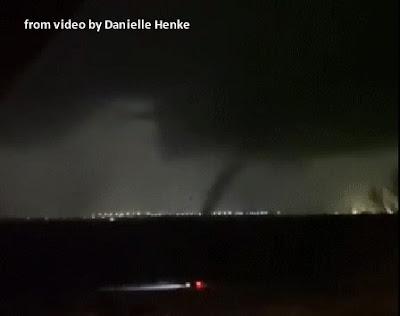
Above, grabs from video by my wife Shawna near and after dark in the Moundridge-Goessel and Marion areas of central KS show tornadoes visible only by lightning, including a large one near Marion Lake.  Associated maps and radar images above also show the tornado paths from that supercell, as well as the more prolific supercell that struck Wichita around 10:20 pm and produced other tornadoes before and after, also after dark.

Tornadoes after dark are particularly dangerous because they are difficult to see, and many people are asleep and not aware of what's approaching.  My paper with Andy Fischer about nighttime tornado environments (see here) shows that tornadoes after dark in the Plains occur when both CAPE and especially low-level shear are large after sunset.  Just as important, storms after dark need to remain relatively "surface-based" (lifted parcels of air near the ground that feed updrafts are able to move upward with little resistance).  This occurs when surface temperatures don't cool much and surface dew points remain steady or even increase, keeping convective inhibition (CIN) relatively small, rather than the more typical scenario where storms become "elevated" above a cool stable layer near the ground when surface temperatures cool significantly after sunset.


CAPE below 3 km  (CAPE closer to the ground) can also be an indicator of a more surface-based environment.  Notice that in the 2 graphics immediately above, along with large CAPE-shear combinations (suggested by both the Sig Tor parameter and the energy-helicity index), there were significant amounts of low-level CAPE indicated after dark on both the SPC mesoscale analysis in real-time, and on model forecasts in advance.  This suggested a continuation of the April 14 tornado event well after dark, which was the case, particularly with the Wichita KS and Woodward OK tornadoes.

Obviously, with this big an outbreak, it is very fortunate that more people weren't killed.  I can't emphasize enough the excellent forecasts and outlooks several days in advance, as well as pin-point warnings and media coverage during the event.

When I get time this coming week, I'll do a post about the setting that generated tornadoes in Minnesota yesterday (4/21/12) with early spring northwest flow aloft and 40's F dew points at the surface (very unusual!).

- Jon Davies  4/22/12

Wednesday, April 11, 2012

"Surviving the Storm: What Storm Chasers Want You to Know" DVD now available!


As I announced at ChaserCon 2012 in Denver, my wife Shawna Davies has spent much of the past year putting together a 30-minute severe weather safety/preparedness program working with several other storm chasers, including James Skivers, Stephen Locke, and Bill and Anna Stromberg. It's now available on DVD for $13.95 at:
************** www.survivingthestormmovie.com **************

With this project, Shawna wanted to use storm chaser knowledge and experience to do something good, apart from the usual storm chasing videos. Here's some excerpts from the Press Release:

With death and injury tolls from tornadoes in 2011 that were staggering, a group of professional storm chasers decided to use their considerable experience with violent weather to make an instructive and entertaining DVD to help people save their own lives when severe weather strikes. This DVD is titled “Surviving the Storm: What Storm Chasers Want You to Know”.

This 30 minute program provides life-saving tips and strategies for individuals and families to protect themselves against all types of severe weather... Safety segments show how to increase survival chances when violent weather strikes both indoors and out, including on the road. In addition, on-the-street interviews quiz people about severe weather knowledge with humor and wit, and a heart-pounding finale shows a mother and daughter acting to save their lives as a tornado strikes their home. Through use of exciting storm chaser footage and re-enactments of life threatening situations, this DVD offers an abundance of knowledge to survive deadly storms and severe weather.

With what appears to be a several-day period of severe weather coming up for the Plains during April 12 through April 16, now seems an appropriate time to announce this DVD. Please buy a copy and let your friends know about it, too. After a deadly year of tornadoes and severe weather in 2011, we really want people to be aware and prepared in 2012!

Thanks!

- Jon Davies 4/11/12